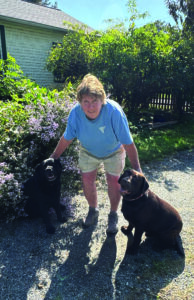
Cindy King, with her dogs Arlo, left, and Rudder, has a yard that has been a Certified Wildlife Habitat for 22 years. It offers a variety of trees, shrub, and berry to offer a haven for birds. (Photo by Makayla Patterson)
Want to make birds happy without lifting a finger? Skip cleaning your yard in the fall, and the birds will thank you.
A yard that hasn’t gone through fall cleanup offers numerous food and habitat resources, which help migrating and residential birds through the winter.
Johnathan Irons, an avid birder who began birding at age 11, explained what to expect from birds this time of year.
“The fall and spring is when you’ll see the most species in Maryland just because you have the resident birds and the ones that are migrating,” he said.
As some birds fly through and others stay, having food and shelter available for them is important.
Cindy King, a Certified Professional Horticulturalist through the Maryland Nursery, Landscape and Greenhouse Association, Inc explained how her yard is set up for the birds this season.
“I have probably 8-10 feeders up at all times. As well as I plant vigorously for the birds, a lot of seed heads and different areas where they can hunt and pack,” she said.
Some examples of seed head plants, according to King, are Rudbeckia, Helianthus and Echinacea.
Her yard, which has been a Certified Wildlife Habitat for 22 years, also offers a variety of trees, shrubs and berry plants.
This time of year, doing maintenance in her yard is not a priority.
“I don’t clean up my yard at all,” she said. “What you see is what will be here. The seed heads are here for the birds. The seed heads on the grasses are here. All the feeding stations are stocked full in the winter.”
The practice of foregoing fall cleanup in a yard is not uncommon if someone wants birds to visit in the fall and winter.
“Most of my plants, if left up, offer something in the winter. Larvas, whether it’s bee larvas, or caterpillar larvas, often what I call hunker down in the middle of plants for the winter. That’s where their chrysalises are. That’s where the larvas can go semi-dormant. And if you leave your plants there, the birds will hunt that duff area and get protein, which they need in the winter,” she explained.
Irons also stressed the importance of this practice.
“You have a brush pile; don’t remove it; that’s really good cover in the fall,” he said. “If you have some kind of a meadow or open space and it’s grown up and not mowed, don’t mow that in the fall; wait until about March or April to mow that because that provides a lot of natural seeds and also cover.”
Irons said it can be frustrating seeing meadows mowed in the fall because it’s a loss of resources.
“They’re just destroying really good habitat,” he said. “It would be the most beneficial throughout the fall and winter when these birds are a little bit more stressed for food and shelter and stuff when it gets colder, and there is less to eat around.”
According to King, birds go for natural resources first.
“Birds will always eat natural resources first. Because they know in their minds that’s what they are supposed to eat.”
While food and shelter are crucial for birds in the winter, fresh water is also important.
“Water is essential,” King explained. “They end up drinking that nasty stuff down the sides of the road if we have a freeze, and that’s not good for them.”
She suggested having a heated waterer or putting water in a black container, which can help slow down water from freezing.
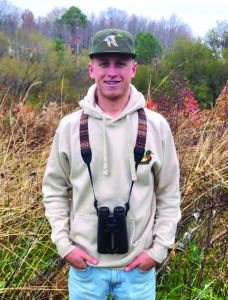
Johnathan Irons has done bird banding for Washington College, breeding bird surveys for DNR, and did a morning flight count for Maryland Biodiversity Project. (Photo courtesy Johnathan Irons)
Besides needing water to drink, birds also need water to clean themselves.
“They have to keep their feathers clean because if they get sticky and dirty, then the air penetrates and they freeze,” King said.
When it comes to bird seed, King suggested black oil sunflower seed.
“I prefer, myself, the black oil sunflower seed. High fat, good protein. Good things for them to maintain their body weight in harsh weather.”
King sees numerous bird species in her yard throughout the winter such as cardinals, wrens, goldfinches, different types of sparrows, and towhees.
“Just being able to look out almost any window in my house and seeing the birds, that kind of thing is what I really like,” King said.
While King’s yard is 35 years in the making, she did have advice for those just starting.
“Start small. Take a 20 by 20 section. Plant it just in perennials that are great for the pollinators, but ones that provide seed heads for the birds.”
King added that it is not too late to start planting. “You can plant any hearty perennial as long as the ground is not frozen more than three inches.”