(Editor’s note: Ron Ketter is a member of the Talbot Bird Club and a Maryland Ornithological Society board member.)
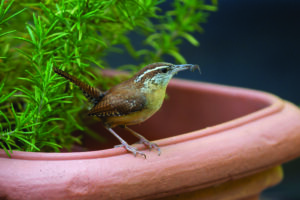
Carolina Wrens are quite resourceful in selecting places to build nests. They are often found inside flowerpots, hanging planters, or mailboxes, under propane tank lids, and even in boots or pockets of coats left outside or in sheds. (Photo by Ron Ketter)
Carolina Wrens are common backyard birds that can be found year around on the Eastern Shore. Their range covers most of the eastern United States.
They are small birds, only about 5 inches long. They are reddish-brown above, buffy-orange below, with white on their chin and throat. A white stripe extends from above their eye to their nape. They have a dark, slender, decurved bill. Both sexes are similar.
Sometimes they are difficult to see as they creep through vegetation while searching for food. Other times, Carolina Wrens are quite energetic, hopping around as they perch on a branch or patio furniture with tails cocked, singing loudly.
Carolina Wrens more than compensate for their diminutive size through boisterous song. The song is notable for both volume and frequency.
Only the male sings. The song is often described as a loud “teakettle, teakettle, teakettle.” In one study, a captive male repeated its song close to 3,000 times in a single day!
Males and females may form pair bonds anytime during the year. Once formed, they pair for life, staying on their territory throughout the year to forage and breed.
The male builds several rudimentary nests and leaves it up to the female to choose the best one. Once the female selects the nest, the pair finishes the nest together.
Various materials are used, including dried grass, pine needles, dead leaves, bark strips, snakeskin, and even bits of paper, plastic, or string. A typical nest is shaped as a dome with a side entrance.
Carolina Wrens are quite resourceful in selecting places to build nests. They are often found inside flowerpots, hanging planters, or mailboxes, under propane tank lids, and even in boots or pockets of coats left outside or in sheds.
Once the nest is finished, the female lays from three to seven eggs. Only the female incubates. The male visits her frequently, often bringing food.
After about two weeks, the eggs hatch. The female eats the eggshell, providing her an important source of calcium. The female continues to stay on the nest, brooding the young to keep them warm for the next several days. During this time, the male brings food to the nest, giving it to the female who then feeds it to the young.
After around four days, the young are large enough and have sufficient feather coverage to keep warm without the female needing to brood them. The female joins her mate in bringing food to the nest. During the next week to 10 days, both sexes participate equally in feeding their babies.
Nestlings are fed a variety of insects, including butterfly and moth larva, spiders, crickets, grasshoppers, and beetles.
When it comes time for the young to fledge, parents visit the nest without food to encourage the young to leave the nest. The young depart by hopping out of the nest or taking very short flights of no more than a few feet at a time.
They are particularly vulnerable during this time, so they tend to find shelter in bushes or brush piles to stay safe from predators.
Parents continue to feed young out of the nest for another three to four weeks. Parental duties are equally divided between the male and female, unless the pair is starting another clutch. If that occurs, the male continues to feed the fledglings while the female starts to incubate the next set of eggs.
While Carolina Wrens do not migrate, they show sensitivity to cold weather. At night or during very cold days, they will seek refuge in nest boxes or in brush piles sheltered from the wind.
While Carolina Wrens’ diet consists mostly of insects, it is supplemented with small amounts of plant matter, such as berries and seeds from bayberry, sweetgum, and poison ivy.
They will also visit feeders containing suet, seeds, or peanuts during the winter months.
The Carolina Wren population has increased over the last half century. They seem to adapt well to most human activity, including benefitting from backyard feeders and artificial nestboxes that help them through the winter.
You can take several steps to attract Carolina Wrens to your backyard. Put up a nestbox or, if you have one, leave it up during the winter to serve as a place they can roost to stay warm. Construct a brush pile on your property.
Reduce the use of insecticides to make sure they have plenty of insects as a food source. And put up a feeder with suet, peanuts, or seeds.
By taking these steps, and with a little luck, you may be greeted by the cheerful song of the Carolina Wren.