(Editor’s note: Ron Ketter is a member of the Talbot Bird Club and a Maryland Ornithological Society board member.)
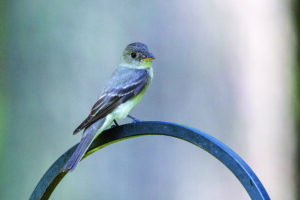
Eastern Wood-Pewees are grayish-brown, darker above and paler below, with two pale wing bars. The top part of their bill (the upper mandible) is dark, while the lower part of the bill (the lower mandible) is orange. Both genders are similar in appearance. (Photo by Ron Ketter)
Eastern Wood-Pewees visit the Eastern Shore from mid-spring to early autumn to breed. They arrive around the end of April or early May from the northern part of South America, where they reside during winter. Their breeding range extends across the eastern half of the United States southern Canada.
They can be found in almost any wooded habitat, including urban forest patches, rural or agricultural wooded areas, riparian forests, and large expanses of mature forests.
While they seem to prefer deciduous forests, they also can be found in pine forests and mixed hardwood-coniferous forests.
Eastern Wood-Pewees are grayish-brown, darker above and paler below, with two pale wing bars.
The top part of their bill (the upper mandible) is dark, while the lower part of the bill (the lower mandible) is orange. Both genders are similar in appearance.
Eastern Wood-Pewees belong to a family of birds known as Tyrant Flycatchers, or new-world flycatchers. This family of birds has the most species of any bird family, with more than 440 separate species in 104 genera.
They all are found in the western hemisphere. While most species reside in Central and South America, about 35 species migrate to the U.S. and Canada to breed.
While Tyrant Flycatchers superficially resemble old-world flycatchers in the bird family Muscicapidae, they are not closely related to them.
This species name is based on the distinctive song the Eastern Wood-Pewee sings: a clear whistling tune that sounds like “PEE-a-weeEEE!”
Bird species with names based on how their songs or calls sound are referred to as “name-sayers.”
Eastern Wood-Pewees generally sing their song from an exposed perch, such as a dead tree limb or a snag on the edge of a forested area. They are one of the first bird species heard in the morning, starting well before sunrise.
They sing throughout the day and are often heard singing well past sunset.
In addition, they sing well into the season. While most bird species stop singing after nesting activity is over, Eastern Wood-Pewees can be heard singing well past this time.
Most songbirds learn their songs from adult birds. During the first few months after hatching, young birds listen to adults and memorize songs, creating a mental template of how the songs sound.
Later, they practice these songs, often through disorganized phrases that sound rather like babbling until they improve over time.
Eastern Wood-Pewees and other Tyrant Flycatcher species are different. Instead of learning from adults, their songs are encoded in their DNA.
They instinctually know their songs. Scientists demonstrated this by pairing flycatchers hatched in captivity with other species and discovering, as adults, they performed their species song with precision rather than copying the songs they heard from other species.
Like all flycatchers, Eastern Wood-Pewees feed almost exclusively on insects. They occasionally eat fruit, representing about 1 percent of their diet.
Mostly they hunt insects using a maneuver called aerial hawking, flying out from an aerial perch to catch insects in mid-air and returning to the same perch.
Their short-bill is specially designed for this purpose, with a fine point but broad base that serves as a flyswatter to catch insects.
Eastern Wood-Peewees are seasonally monogamous. Males and females pair up shortly after they arrive on breeding grounds.
Once paired, both adults will visit several potential nest sites to determine a suitable nest location in a tree branch fork away from the trunk of the tree. Most nest are between ten to thirty feet above the ground.
The female does most of the nest building. The nest consists of grasses, animal hair, strips of bark, leaves, moss, and lichen, held together using spider webs and fibers to form an open cup about three inches in diameter, with an interior cup about two inches across and one-and-a-half inches deep.
The female lays three eggs and is responsible for incubation. The male brings his mate food during this period and stays near the nest. Incubation takes twelve to fourteen days.
The young are fed in the nest for around two more weeks before they fledge. They continue to be cared for by their parents for another three to four weeks before they become independent.
Although a common bird, Eastern Wood-Pewees have been declining over the last half century.
Annual bird surveys indicate the North American population has decreased by 44 percent since 1966. Some of the reasons for this decline may be increased use of insecticides, which affects their food supply, as well as overpopulation of white-tailed deer affecting the intermediate tree canopy structure in heavily browsed areas.
While Eastern Wood-Pewees are unlikely to visit a feeder, they may be found in your backyard if you have a wooded patch or live near a patch of forestland, especially if there are native species that attract flying insects nearby.