The spotted lanternfly won’t bite or sting you, but state officials, farmers and plant lovers want you to kill any on site.
Spotted Lantern fly (Lycorma delicatula) is a planthopper native to eastern Asia. In 2014 a stone shipment was sent to Berks County PA with spotted lanternfly and every year since, the pest has spread it’s territory. Maryland’s first sighting was in 2018 in Cecil County and the Mid-Shore counties fell under a state quarantine in 2023. Still, more of the bugs are popping up in the area and anyone can help by squishing or stomping them out. 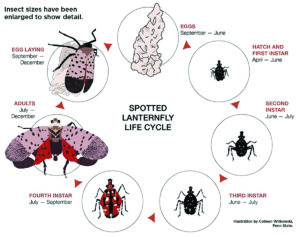
At each of it’s life stages, spotted lanternfly changes drastically in appearance, so it’s also good to know what to look for.
Egg masses look like a white or gray pasty spot on tree trunks and branches. Instars are black with white spots, changing to red and black with white spots and adults have pink outer wings covering red and black inner wings, both with black spots and tips.
Spotted lanternfly do not feed on flowers, leaves or fruit. Instead, they eat phloem or sap from the trunks and stems of their host plants. They are also non-toxic if ingested by pets. They pose no danger to you or your pets.
But without natural enemies here or an efficient pesticide option, they will attack many popular plants in the landscape.
The primary host of spotted lanternfly is tree of heaven (Ailanthus altissima). Tree of heaven is also an invasive species, which has been in the U..S. for hundreds of years. However, spotted lanternflies have about 70 secondary hosts including: wild and cultivated grape, black walnut, red maple, silver maple, weeping willow.
Honeydew is excreted by spotted lanternfly. It is made up of sugar and water. Honeydew will sit on leaves and create something called sooty mold. This sooty mold will reduce the plants’ ability to photosynthesize. When it sits on decks, furniture, cars and other outdoor furniture or equipment, it can become sticky and difficult to remove.
For residential areas, the Maryland Department of Agriculture recommends mechanical controls to defend against spotted lanternfly. Flyswatters and nets are easy ways to catch and kill spotted lanternfly. Hand vacuums or shop vacuums can remove spotted lanternfly from vegetation and structures around your property. Spotted lanternfly caught can simply be thrown away.
Circle traps can passively trap spotted lanternfly. They do not require a lure or any chemicals. Spotted lanternfly are poor flyers and climb up trees to feed on stems and jump to glide to their next location. The circle trap cuts off access to the tops of trees and funnels them into a plastic bag. This bag can be replaced and the old one thrown away. MDA does not recommend sticky tape or glue traps, as they have a high rate of by-catch, often leading to beneficial insects, small mammals, reptiles and even birds getting caught.
Removal of egg masses in the winter is also effective. Every egg mass you remove is 30 – 50 less spotted lanternfly that will hatch in the spring.
If you have tree of heaven on the property you can remove it. To successfully remove tree of heaven you will need to completely remove its roots system. Cutting it down will trigger a defense mechanism resulting in shoots emerging around the base of the cut tree.
Using tree of heaven as a “trap” tree is also an option. Setting up circle traps on these trees can result in mechanical removal of spotted lanternfly.