(Editor’s note: Ron Ketter is a member of the Talbot Bird Club and a Maryland Ornithological Society board member.)
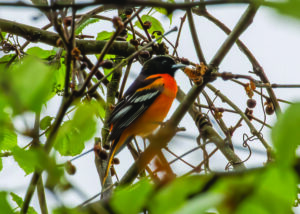
Baltimore Orioles are medium sized songbirds, slightly smaller and more slender than American Robins. They have long, thick-based bills that come to a sharp point. (Photo by Ron Ketter)
Perhaps no bird is more closely associated with Maryland than the Baltimore Oriole.
Whether identified as the State Bird of Maryland or associated with Baltimore’s major-league baseball team, the Baltimore Oriole has long been tied to the history of Maryland.
In 1698, a shipment of “Birds & beasts of Curiosity” sent from Maryland to England included several “Baltemore Birds.” In 1731, Mark Catesby described and illustrated the “Baltimore Bird” in his Natural History of Carolina, Florida and the Bahama Islands. He noted how the plumage resembled the coat of arms colors of Sir George Calvert, 1st Lord of Baltimore.
Based on Catesby’s documentation, Carl Linnaeus included the species in his 1758 scientific publication Systema Naturae, noting its similarity to old world (Europe and Asia) orioles belonging to the family Oriolidae. That’s how it became known as the Baltimore Oriole.
Despite their similarities, New World Orioles (those found in the Americas) are not closely related to Oriolidae species. Instead, they belong to a family of birds called Icteridae, which include species commonly referred to as “blackbirds.”
Baltimore Orioles are summer residents of the Eastern Shore, typically arriving during the last half of April. They prefer deciduous trees, mainly open woodlands, forest edges, orchards, parks, river or creek edges, and backyards. Their breed throughout the United States east of the Rockies, extending into the southern parts of Canada. They overwinter from Mexico, through Central America, and into the northern parts of South America.
Baltimore Orioles are medium sized songbirds, slightly smaller and more slender than American Robins. They have long, thick-based bills that come to a sharp point. Adult males are bright orange with mostly black wings and a solid black head.
They have a single, broad white wing-bar, with white edges on their wing feathers. Females and immatures are yellow-orange on the breast, with a grayish head and back, and two white wing bars.
The musical song of a Baltimore Oriole is a series of clear whistling notes, flute-like in quality, tied together in brief phrases. Some of the mnemonics used to describe the song include whistling “chitty chitty bang bang”, “Here, here, come right here, dear”, and “Here I am! Look at me!”
While the male is the primary songster, females sometimes sing, although their songs mostly consist of a few descending, whistling notes rather than the more complex songs performed by males.
As soon as they arrive on their breeding grounds, male Baltimore Orioles claim territory and try to attract a mate.
Males enthusiastically court females by singing, hopping in front of her, and bowing while lowering his wings and fanning his tail. While some females ignore these displays, others will sing back and give a wing-quiver display by fanning her tail and fluttering her wings.
Once a pair bond is established, nest building begins. Oriole nests resemble an enclosed basket woven from plant material and hanging below a slender tree branch.
The female builds the nest with the male sometimes helping by providing nesting material.
The female builds the nest in 3 stages. She first crafts an outer bowl using flexible plant, animal, or human-made fibers that provide the main support for the nest.
Springy fibers are used for the second stage by making an inner bowl to maintain the nest’s shape. Finally, downy feathers are used to create the nest lining.
The female works with one fiber at time, often clinging upside down from the main twig or branch to weave the fiber into the nest.
This painstaking work can take from seven to 15 days to complete.
A typical nest has four or five eggs.
Only the female incubates for around two weeks until the eggs hatch.
Both parents then feed the nestlings by bringing caterpillars and soft parts of other insects (from grasshoppers and dragonflies) to the nest.
The young fledge after 12 or 13 days. Parents continue to feed the fledglings for another two weeks, at which time the young are on their own. By late summer, Baltimore Orioles begin migrating to parts south.
Currently, there are estimated to be 12 million Baltimore Orioles. They have been declining steadily at an average rate of about 1.5% per year over the last 50 years. Dutch elm disease devastated American Elm habitat, and with it the preferred nesting trees of Baltimore Orioles.
This spring, keep watch for an orange and black bird and listen for a lively tune. You might be fortunate to see our state bird, the Baltimore Oriole.