(Editor’s note: Ron Ketter is a member of the Talbot Bird Club and a Maryland Ornithological Society board member.)
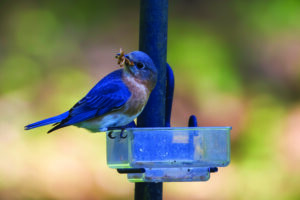
A nest full of young bluebirds can consume up to 2,000 insects per day. Their diet mainly consists of caterpillars, spiders, crickets, grasshoppers and beetles. (Photo courtesy Ron Ketter)
astern Bluebirds are year-round residents on the Eastern Shore. The United States has three bluebird species, with the Eastern Bluebird the most widespread species and the only one found in the eastern states.
A member of the thrush family, the Eastern Bluebird is relatively small, about two-thirds the size of our most widely known thrush, the American Robin.
The male Eastern Bluebird is royal blue on its head, back, wings, and tail. It has a reddish-orange throat, breast and sides, with a white belly. Females are generally duller, with gray backs, blue wings and tails, and more brownish red coloration in the neck and breast.
Their song consists of several phrases in a low tone, each consisting of a warbling set of three notes. They also have a call that sounds like a subdued tu-a-wee.
Eastern Bluebirds are secondary cavity nesters, meaning that they do not create the cavities in which they nest.
Instead, they use old woodpecker nests, natural hollows in decaying trees, or constructed nestboxes. I even found a pair nesting in a decommissioned artillery gun at Fort Miles Historic Area at Delaware’s Cape Henlopen State Park.
During the early twentieth century, Eastern Bluebird populations declined sharply when they were outcompeted for natural nesting cavities by two introduced species, House Sparrows and European Starlings. Eastern Bluebirds were no match for these larger and more aggressive species.
Conservation campaigns starting in the 1960s helped reverse these trends by promoting bluebird trails in parks and on agricultural lands. Changes in nest box design along with active monitoring programs helped deter non-native species from using these boxes, allowing Eastern Bluebirds to quickly adopt their use.
The mating behavior of Eastern Bluebirds starts early. Some pairs form while still in flocks during non-breeding season.
Others wait until the start of breeding season when they are near nesting sites.
Males often perform a nest demonstration display to attract a mate. This involves the male holding nesting material near a nest box or other cavity opening while rocking and waving its wings. The male will then enter the box while holding the material. When a female enters the nest opening, a pair bond usually forms. That is unless the male promptly rejects the female by removing nesting material.
Once a pair bond is formed, the female is solely responsible for building the nest. Nests consist of grass or pine needles arranged inside the cavity, with a distinctly formed cup lined with fine grasses and possibly animal hair or feathers.
Nests can be built in a single day, although they may take several days to complete.
After finishing the nest, the female begins laying eggs at the rate of one per day, usually in the morning. The eggs are pale blue or blue-green, and about seven-eighths of an inch long.
Typically, she lays five or six eggs, although there may be as few as three or as many as seven.
After the last or second-to-last egg is laid, the female begins incubating the eggs, another responsibility not shared by the male. Incubation takes between 11 and 19 days, shorter during warm weather and longer during colder weather.
While the male’s only duty during incubation is tending to the female, such as bringing her food, he shares responsibility with the female in tending the chicks once the eggs are hatched. Both adults are busy at this time, as a nest full of young bluebirds can consume up to 2,000 insects per day. Their diet mainly consists of caterpillars, spiders, crickets, grasshoppers, and beetles.
Nestlings have evolved a unique way of helping to keep the nests sanitary. After digesting their food, they produce fecal sacs consisting of a mucous membrane that surrounds their feces. Adults will carry this organic diaper and dispose of it away from the nest.
Baby bluebirds fledge in 17 to 21 days. The young continue to rely on the parents to feed them for another three weeks after they leave the nest, and then they are on their own. The adults often have two or three broods during a single breeding season.
A pair of adult bluebirds will stay together throughout the breeding season, and there is evidence that some mate for life.
However, this isn’t always the case and divorces sometimes occur. Sometimes a pair “divorces” during the season to find different partners, especially if the pair is unable to breed successfully.
Even if the pair stays together, about five percent of the time either the male mates with more than one female (known as polygyny) or the female mates with more than one male (polyandry).
If you are in an area suitable for Eastern Bluebirds, you can attract them to your backyard by creating the right conditions. This involves planting native plants to host native caterpillars, providing clean water, and putting out some bird food such as meal worms.
You might also consider installing a nest box.
If you do, it is best to check out the many on-line resources available to select the appropriate nest box and learn the best way to install it, including how to deter non-native bird species and how to use predator guards to keep the nest safe from snakes, raccoons, outdoor cats, and other hazards.