(Editor’s note: Ron Ketter is a member of the Talbot Bird Club and a Maryland Ornithological Society board member.)
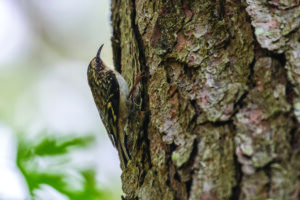
Brown Creepers’ contrasting white underparts are often hidden next to the tree trunk, allowing them to blend in against the bark. (Photo by Ron Ketter)
Brown Creepers are tiny birds that visit our area during the fall and winter months. They are well camouflaged, blending in as they creep along tree trunks, exploring crevices in the bark for food.
The Brown Creeper is one of nine species found in the genus Certhia and is the only one of the nine species found in the Western Hemisphere. Its range covers most of the U.S., extending to the southern half of Canada and southeastern Alaska. Their southern range extends into the central parts of Mexico and Central America.
Brown Creepers are quite small. They are about five inches long and weigh less than one-third of an ounce, or slightly less than the weight of two nickels. Despite their small size, they seek out the largest trees and limbs they can find.
These birds have slim bodies, streaked brown and buff on their wings, back, and tail. Their contrasting white underparts are often hidden next to the tree trunk, allowing them to blend in against the bark. They have a long downward-curved bill, well designed for probing in and under bark crevices in search of insects and spiders.
They have very short legs. This, combined with their long, spiny tails used to brace them against the tree, allows them to blend into tree trunks as they probe for food.
One of the best ways to identify Brown Creepers is by behavior. Look for a small bird that flies to the bottom of a tree and works its way up the tree trunk. After moving up to the tree, often reaching near the top, they will fly down to the base of a nearby, or sometimes the same, tree and repeat the process again.
Both Brown Creepers and the similarly sized Nuthatch species climb along tree trunks and large branches probing for insects, larvae, spiders, and spider eggs.
However, they differ in how they forage. Nuthatches start higher on the tree with their head directed toward the ground and they move down the tree.
Brown Creepers start at the base of the tree and work up the trunk, zig-zagging or spiraling as they work the bark. Their unique anatomy makes it difficult for them to move backwards or sideways. Instead, they may hop to the side.
If a Brown Creeper and a Nuthatch are on the same tree, you might see them passing in opposite directions as they forage along the tree trunk.
Although both species are seeking the same food sources hidden in bark crevices, by inspecting the bark from different angles they don’t compete for the same morsels of food.
Other than in some isolated areas in Worcester County, Brown Creepers are unlikely to be found on the Eastern Shore during the summer. They tend to relocate to western Maryland and other parts to breed.
During the breeding season, they prefer mature coniferous or mixed forests, with a concentration of large live trees for foraging and large dead or dying trees with loose bark for nesting.
The female builds the nest, typically located between a loose piece of bark and the tree trunk.
Nest construction consists of two stages. The first stage is building a foundation that resembles a hammock. The female uses sticky insect cocoons and spider egg cases to attach twigs and small bark strips to the inner part of the loose bark. Once that is completed, the female then makes an inner cup using fine material such as animal hair, feathers, grass, lichens and mosses.
The female lays five or six eggs, either all white or sometimes white speckled with pink or reddish brown spots. The female is responsible for incubation duties, lasting an average of 15 days. Nestlings fledge after around 17 days.
According to data from the Breeding Bird Survey, the Brown Creeper population has been stable with even a slight increase over the last 50 years.
This is especially true in the eastern part of North America due to reforestation efforts. The story is more complicated in the Western states due to timber harvesting, especially in old-growth forests where large diameter trees have been removed. Removing dead and dying trees also affects their population since they rely on these trees for breeding habitat.
While Brown Creepers rarely come to feeders, they are often found near species that do, such as Carolina Chickadees and Tufted Titmice.
If you have some nearby trees with large trunks, keep an eye out for Brown Creepers and their unique behavior. You can also try to entice them by spreading suet on the bark of a tree or mounting a suet feeder directly on a tree trunk.