(Editor’s note: Ron Ketter is a member of the Talbot Bird Club and a Maryland Ornithological Society board member.)
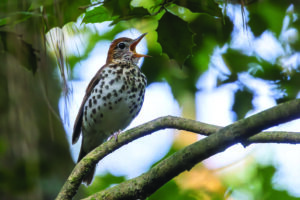
During parts of its song, male Wood Thrushes sing two notes simultaneously. Birds vocalize by using their syrinx, a Y-shaped organ that connects to both lungs. By controlling airflow to each side independently, it can produce two notes at one.
Wood Thrush prefer interior forested areas. While it is unlikely to visit backyard feeders, if you live near a wooded area, you might hear its haunting springtime song or get a look at this cinnamon-brown bird with a white, boldly spotted breast and belly.
Different birds prefer different habitats. Some prefer open grasslands, marshes, or forest edges. But certain are rarely found outside of large, contiguous tracts of forested areas (typically 50 or more acres).
They are referred to as Forest Interior Dwelling (or Dependent) Species, or FIDS for short.
According to Maryland Department of Natural Resources, 25 FIDS species breed in Maryland, including 20 neo-tropical migrants. This later group includes the Wood Thrush.
Wood Thrush spends its winters in Central America. They return to the United States each spring, migrating across the Gulf of Mexico. Their breeding range covers the Eastern half of the United States extending into the southern parts of Canada’s eastern provinces.
By mid-to-late April, Wood Thrush arrive in Maryland.
A few days after arriving on breeding grounds, the male start singing near dawn and dusk. Their flute-like song is often described as an ethereal “ee-oh-lay,” repeated frequently after about a two second pause. Henry David Thoreau called it the “Shakespeare among birds” based on the quality of its song, writing in 1853 that it is “the only bird whose note affects me like music. It lifts and exhilarates me. It is inspiring. It changes all hours to an eternal morning.”
During parts of its song, male Wood Thrushes sing two notes simultaneously. Birds vocalize by using their syrinx, a Y-shaped organ that connects to both lungs.
By controlling airflow to each side independently, it can produce two notes at once. Many thrushes practice this, with the Wood Thrush being among the best.
Once the male establishes territory and attracts a mate, which may take only a few days, the pair selects a site for a nest.
The typical nest site is in a fork of a branch in a tree or shrub, averaging 7.5 feet above the ground, concealed by vegetation. The female is the primary nest builder with some assistance from the male.
The final nest is about 5 ½ inches across, consisting of dead grass and stems, but may also contain pieces of pliable plastic and paper. Mud is used to form the interior cup, with a final lining of small roots. The female typically lays three to four eggs.
Only the female incubates the eggs, with the male watching from a distance.
Incubation takes 12 to 15 days, with another 12 to 15 days feeding the young before they are ready to leave the nest. Both parents feed young in the nest.
After the first brood fledges, both parents feed the young outside the nest for another two to three weeks.
During this time, the male does more of the feeding, freeing up time for the female to build a second nest and prepare for a second clutch of eggs.
If they are successful at fledging a second brood, the parents will split up the young with the father feeding some of the fledglings and the mother feeding the others.
Wood Thrush are susceptible to brood parasitism from Brown-headed Cowbirds. Brood parasitism occurs when a female of one species lays an egg in another species’ nest.
The host species will then incubate the Cowbird egg and raise the hatchling. Cowbirds evolved as a bird of the great plains, following Bison herds and feeding off insects stirred up by the Bison.
Given their nomadic nature, they relied on other species to hatch and raise their young.
Wood Thrush populations have decreased by around 50 percent over the last half century. A major reason for the decline is forest fragmentation.
Fragmentation affects Wood Thrush by not only reducing the amount of forested area, it also exposes the remaining forests to more extensive edge habitat.
Cowbirds are particularly active along forest edges, leading to more Cowbird eggs in Wood Thrush nests.
If you live near or visit a large tract of forested area, listen for the haunting sound of the Wood Thrush.