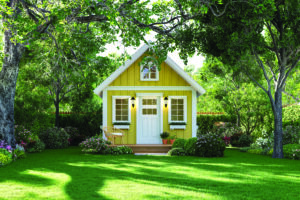
With persistent housing shortages and sustained demand for living on Maryland’s Eastern Shore, accessory dwelling unit could be more commonplace in the years to come.
Mother-in-law suite, backyard cottage, Granny flat or Casita. Call it what you will, but an Accessory Dwelling Unit — a secondary livable structure built on the same parcel as a primary single-family unit could be more commonplace in the years to come on the Mid-Shore!
Persistent shortages in housing inventory and recent changes in state law that streamlines and promotes so-called ADU construction is part of the recipe, realtors and planners say, but awareness of them as and option for new housing is still low and they are not without their own hurdles.
A recent report commissioned by the Maryland Department of Housing and Community Development in 2021 found that Maryland lacks about 85,000 rental units for people earning 30 percent of the area median income or below.
That report also found that Maryland is expected to add an estimated 97,200 low-income households between 2020 and 2030.
Concern over housing issues among Marylanders has jumped by double digits on issues related to housing supply.
In a recent statewide poll, Maryland Realtors found that about 71 percent of Marylanders surveyed said the cost to buy a home in their part of the state is too high, up 14 percentage points from 2020.
Half of those surveyed also indicated that housing availability was a “big or moderate problem,” compared with 35 percent in 2020.
Concern statewide led to the Maryland Legislature passing the Accessory Dwelling Units Act to promote and encourage the creation of ADUs and require county and municipal regulations must follow the intent of the state law.
The Maryland ADU Act defines them as “a secondary unit on the same lot, parcel, or tract as a primary single-family detached dwelling unit and that is not greater than 75 percent of the size of the primary single-family detached dwelling unit.”
The bill further states that ADUs can be a separate structure from the primary unit or attached as an addition to the primary unit.
Generally, an ADU is approximately 800 square feet or less, has a cooking space, one bathroom, and some system in place for climate control.
“Every county and municipality has a definition,” said Holly Baldwin, who recently joined with Chris Jordan Jr. Solutions to form ADU Solutions as a type of guide service for people considering or going through the permitting and building process. “I often talk about them as backyard cottages and that gives them a better visual.”
“The process typically requires obtaining a building permit from your local jurisdiction, ensuring compliance with zoning regulations, and undergoing inspections before occupancy,” according to Clarksville Construction, an ADU builder. “ADUs must follow local rules regarding size limits, parking, and entrances, and every county may impose slightly different requirements.
“In short, no matter where you live in Maryland, you will need to secure permits and demonstrate compliance with zoning and building codes before you can legally construct and occupy an ADU.”
At an informational meeting she offered in June, she said there was strong interest from attendees in constructing an ADU on their properties as well as some coming in search of immediate housing.
“The interest is really high,” she said. “The light bulbs are going off.”
Having interest is one thing, but Baldwin said getting a project to completion is a whole other endeavor and could be fraught with pot holes and obstacles for property owners, especially those who weren’t part of building their primary structure.
“We talk very specific about goals,” Baldwin said. “When you’re in the business of telling people what they can and can’t do with the land they own, communication is so important.”
Chuck Kasky, CEO of Maryland Realtors, shares several ways an ADU can improve a property beyond a place for someone to live.
Adding an ADU can significantly increase property value, making it an attractive feature for future home buyers. They provide a buffer for recent college graduates, enabling young adults to save and plan their next move in the comfort of a family-owned ADU.
For those who love to entertain or have extended family stay over, ADUs offer a private and comfortable space for guests.
They serve as a sanctuary for aging parents who desire proximity to their loved ones while maintaining their independence.
They can also be a place for a new graduate returning home and entering the workforce.
Homeowners can leverage ADUs as a source of passive income through renting, either short- or long-term, offering an investment opportunity.
With the state law going into effect last October, counties are still in some stage of updating zoning codes to entice more ADUs.
So changes will be coming.
“It’ll be interesting what happens in the next 10 years,” Baldwin said. “Regardless of what happens with the economy, we’re going to need more housing.”