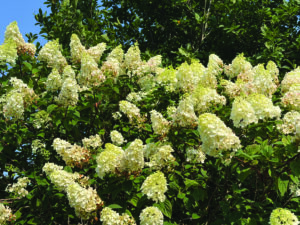
The Panicle Hydrangea, like the Vanilla Strawberry above, blooms best on new growth, so it is wise to prune the plant in late winter or early spring. This new growth will grow 6-8 feet tall and 4-5 feet wide. (Photo by Ginny Rozenkranz)
August can be hot and dry and many of the early summer flowers are done for the year.
That is not the case for the Panicle Hydrangea, which begins to bloom in July and continues to bloom with new flowers to mix with the older ones until September.
Unlike the Big leaf Hydrangea, the Panicle Hydrangea blooms best on new growth, so it is a great idea to prune the plant in late winter or early spring.
This new growth will grow 6-8 feet tall and 4-5 feet wide.
Each flower cluster can hold both fertile and sterile flowers and are packed on a terminal flower panicle that can grow 6-8 inches long.
The sterile flowers are large and very showy while the smaller fertile flowers attract lots of butterflies and other pollinators.
The flowers of Strawberry Sunday Hydrangea begin their journey as creamy vanilla white petals that mature to soft pink that with the cooler nighttime temperatures, then turn to darker pink and then red.
The panicles look like vanilla and strawberry swirled ice-cream cones!
By early autumn the plants will be loaded with newly blooming vanilla, later blooming pink and late blooming red flowering panicles.
As the ends of each branch hold the flower panicles, the branches begin to arch gracefully with their weight.
These are heat-tolerant and the most cold-hardy hydrangeas, thriving in USDA zones 3-8 and love to live in a full sun garden with some late afternoon shade.
They prefer to grow in rich, well drained soil.
These lovely flowers do not depend on the soil pH for their color.
Another beautiful panicle hydrangea that can bring color into a garden is “Limelight,” which grows 6-8 feet tall and the flowers turn lime green, while Pinky Winky grows 6-8 feet tall and is covered with clusters of panicles up to 16 inches long filled with white and pink flowers.
(Editor’s Note: Ginny Rosenkranz is a commercial horticulture specialist with the University of Maryland Extension.)