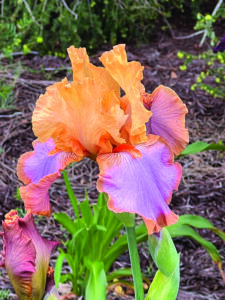
Most Tall Bearded Iris plants, like this Grand Canyon Sunset, bloom in May while there are a few that will later re-bloom in the cooler months in the autumn. (Photo by Ginny Rosenkranz)
May is when the temperatures are finally starting to stay warm without the chance of a cold frost during the evening.
It is also the month that Tall Bearded Iris plants, also called “common flag, ”begins to open their colorful flowers that bloom in a rainbow of colors.
Most bloom in May while there are a few that rebloom in the cooler months in the autumn.
These beautiful perennial plants thrive in full sun and rich, well drained soils.
Iris has strong, above ground rhizomes that need to be planted about an inch above the soil line and lightly mulched without covering the rhizome.
Colorful fragrant flowers grow on 2- to 3-foot-tall stems that rise above the sword shaped green leaves.
Each stalk will produce up to 6 flowers. The flowers have three inner petals that stand erect and are called ‘standards’ and three outer petals that spread then arch downwards called “fall.”
The petals come in many colors ranging from soft light purples to dark rich purples that are often thought black.
Other colors include all shades of blue, soft pale pink through reds, all shades of yellow to orange and pure white.
The standards and the falls can be the same colors or contrasting colors while some have a white blotch on the “falls.”
Some have colorful veins that contrast to the bright blooms. The petals can have a smooth margin while others are ruffled or lightly wavy.
Only the “fall” petals have the bright orange or yellow (sometimes white) stamens which give the flowers their common name of Bearded Iris.
There are thousands of colorful Irises but only hundreds that are re-blooming, and every catalog that sells Iris will present a colorful list with interesting names.
“Immortality” is probably the most famous re-blooming Iris, with pure white, softly ruffled petals while “Grand Canyon” sunset has soft yellow orange ruffled standards and purple falls that are edged in light orange with orange veins and bright orange fluffy stamens.
The plants spread by creeping rhizomes that grow in clumps over the ground and should be divided with the oldest part of the rhizome removed before replanting.
These colorful, easy to grow flowers are deer and drought tolerant, thriving on the sandy, well drained soils of the Shore.
(Editor’s Note: Ginny Rosenkranz is a commercial horticulture specialist with the University of Maryland Extension.)