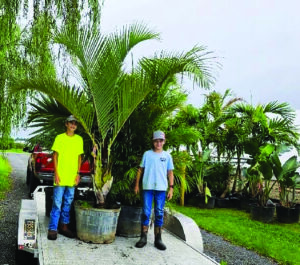
Jay Baxter’s sons, Jude and James assist in palm delivery through Baxter’s Salted Roots greenhouse business. (Photo courtesy Baxter family)
As more people settle down along the Delmarva coast, especially for those seeking respite in retirement, they’re also often bringing dreams of creating their very own backyard oasis, palm trees and all
The trouble is that most tropical plants like palms can’t survive volatile Mid-Atlantic winters.
“What if we had a facility to put those palm trees inside so they’re no longer just being discarded?” wondered Jay Baxter, a fourth-generation farmer from Delaware.
It turns out he did have such a space — 10 greenhouses, to be exact — to recently launch a new endeavor alongside his wife, Jessica, to help these tropical plants overwinter as part of their Salted Roots greenhouse business.
“We’re providing a cost-competitive product versus just bringing more fresh palm trees up from Florida and throwing them away at the end of the year,” Baxter said.
At A Little Farm and Nursery on Kent Island, owner Christy Little said she’s seen the same rising trend of more folks buying more and more palms.
For her, the seasonal drops in temperature mean her outdoor paradise just becomes an indoor one.
“Luckily I have one room that has higher ceilings,” she said with a laugh.
The farm also uses a hoop house with a pellet stove that keeps the other tropicals well and warm through the winter.
Little sells a variety of tropical plants, including several species of palm trees, as well as fresh eggs, fruit and more.
She said a palm tree sells for about $50 to $100 and up.
“It costs a considerable amount of money, and obviously in this day and age, you don’t want to throw your money out when the cold comes and your tree dies,” she said. “There are a few that are hardy here. For the most part, the big coconut palms and the ones we envision in that tropical paradise, they are not hardy here.”
Baxter described the new business aiming to meet that need as a kind of lease where people or businesses can buy palms for the summer season and then sell them back, so Baxter can provide them with the care, space and warmth needed to overwinter. And then the process repeats each season.
“We have seen many creative uses of farm properties in recent years in the growing field of agritourism, both in Delaware and nationwide,” said Michael Lewis, a spokesman with the Delaware Department of Agriculture who said the department is unaware of anyone else in the First State doing what Baxter is doing with palm trees. “From you-pick opportunities to farm tours, hay rides, corn mazes and more, we are always excited to see the unique ways First State farmers promote their properties and products.”
In addition to traditional family farming — growing vegetables like corn and soy and raising broiler chickens for Mountaire Farms — the Baxter family has been diversifying its business for at least a decade by first growing ornamental flowers for wholesalers.
“I joke that it was like the poultry industry: They would bring us little, baby flowers and we would grow them into bigger flowers,” Baxter said. “A lot like the poultry industry, but it smelled a lot better.”
Salted Roots first bloomed out of a contract to provide annual flowers like impatiens and begonias to a wholesaler.
When that company’s reliance on contract growers changed, so too did Baxter’s business model.
Baxter still grows those annual flowers, now for more localized markets, but in the offseason ended up with several months of empty greenhouses.
During the winter, those houses now host hundreds of palm trees of various sizes and types.
From plants sitting cozy in three-gallon pots, to 22-footers, Baxter is offering his greenhouse space as a place for these tropical trees to overwinter — and saving their owners the cost of tossing and replacing them next season.
The operation is at the heart of Baxter’s family farm in Stockley, Del., a rural area of Sussex County nestled about halfway between Millsboro and Georgetown.
The biggest challenge so far, Baxter said, has been dealing with recent harsh winters that have led to higher-than-usual heating costs.
He said he relies on propane to heat his greenhouses.
“Nobody grows palm trees around here so we have to learn as we grow,” he said of the unknown challenges that the new, niche business that currently serves just southern Delaware faces in keeping the plants happy and healthy.
They’re one commercial season in and still figuring things out, he said.
“We love what we do and the way that we have diversified our family business,” he said. “The love of us growing is what drives us.”