(Editor’s note: Suzette Stitely is a member of the Talbot Bird Club and travels extensively for birdwatching.)
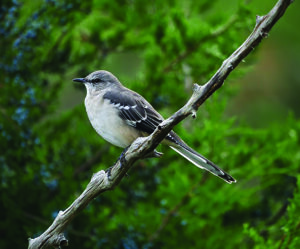
Mostly gray with white underparts, the mockingbird has two white wing bars, a long tail and white patches in its wings. The wing patches are seen when the bird flies or when it raises its wings. (Photo courtesy Suzette Stitely)
A bird seen year round in our area is the Northern Mockingbird and if you have some
bushes in your yard you probably have noticed this striking bird.
Mostly gray with white underparts, the mockingbird has two white wing bars, a long tail and white patches in its wings.
The wing patches are seen when the bird flies or when it raises its wings.
The bird raises its wings as it walks along the ground. We’re not sure why they do this, but it’s possibly to startle insects or as a territorial display.
Northern Mockingbirds are best know for their singing that mimics many other species.
Individuals continue to learn songs throughout their lives.
More than once, I have been fooled by the mockingbird in my yard singing the song of Eastern Phoebes.
If you’re bothered by a bird singing all night long in the summer, it’s probably an unmated male mockingbird.
The female sings less frequently and her song is not as complex.
Northern Mockingbirds are omnivores eating a variety of insects and switching to fruit in the winter.
They love the fruit of the Multiflora Rose which also provides great habitat to escape predators and hide nests.
Their twig nest is built by the male and lined with fur, hair or trash by the female. Mockingbirds usually don’t reuse nests even when they have multiple clutches.
Eggs are bluish with brown speckling and hatch in about two weeks.
Nestlings are fed by both parents and fledge about twelve days after hatching.
The parents continue to feed the fledglings and the young adults stay in the area until the next year.
Learn more about birds, including the Northern Mockingbird, by joining the Talbot Bird Club.
The Talbot Bird Club welcomes anyone who has an interest in birds, whether a novice or experienced ornithologist, and whether you enjoy watching birds at your feeder or traveling throughout the world.
Our members learn from one another and are willing to share their knowledge. The Talbot Bird Club is part of the Maryland Ornithological Society and also has a Facebook page.