(Editor’s note: Suzette Stitely is a member of the Talbot Bird Club and travels extensively for birdwatching.)
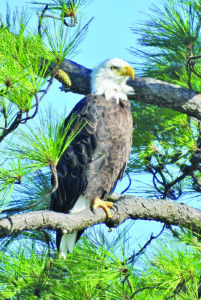
The Bald Eagle is the largest raptor in Maryland weighing 6-10 pounds. (Photo courtesy Suzette Stitely)
On the Eastern Shore, we are very lucky to be able to claim the Bald Eagle as a backyard bird. If you don’t see them soaring over your yard, take a drive to Blackwater National Wildlife Refuge and you’re just about guaranteed to see one.
The Bald Eagle is the largest raptor in Maryland weighing 6-10 pounds. They are mottled brown until 4-5 years old when the adults develop white heads and tails and their heavy beak turns yellow.
Bald Eagles aren’t picky eaters and they will take live prey as well as eating carrion.
Their preferred diet is fish and It’s quite a sight to see this large, graceful bird as it hunts while soaring then quickly dives to catch a fish in their talons. If unsuccessful, they will bully an Osprey to steal their meal. Bald Eagles also eat aquatic birds (even taking Canada Geese and herons) and mammals (muskrat, squirrels, frogs). Roadkill in our area is frequently scavenged by Bald Eagles.
Another amazing behavior to observe is the courtship display which in Maryland starts in December.
Adult birds will soar together then lock talons and cartwheel towards the earth breaking apart right before impact. These aerial “dances” help to establish the bond between pairs which is thought to be for life.
Bald Eagles work together to build their stick nest which is the largest of all birds. The largest on record was estimated to weigh four tons!
Bald Eagles in Maryland lay eggs in March and the average number is two. There’s usually just one clutch annually. Both parents incubate the eggs for about 35 days.
Once hatched, nestlings are covered in down. Nestlings grow quickly and both adults feed the young. Fledgling occurs at about 12 weeks of age and often results in landing on the ground where parents will continue to care for them.
Young birds stay with their parents for a few months before they go out on their own.
Learn more about birds, including the Bald Eagle, by joining the Talbot Bird Club.