(Editor’s note: Ron Ketter is a member of the Talbot Bird Club and a Maryland Ornithological Society board member.)
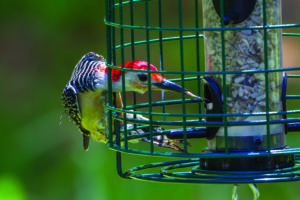
All woodpecker species have long, sticky tongues used for extracting food. The Red-bellied Woodpecker can extend its tongue two inches beyond the tip of its beak! When not collecting insects, the tongue wraps around the back of its skull, helping to cushion the brain. (Photo by Ron Ketter)
Red-bellied woodpeckers are a common bird of the eastern United States. They can be found wherever a wooded patch is nearby.
This medium sized woodpecker is a year-around resident on the Eastern Shore. They are pale below, with a black-and-white patterned back. Adult males have red that extends from their forehead, across the top of their head (the crown) and continuing down their nape. Adult females have red only on the nape but are otherwise similar to males.
If you look closely, you can see some pale red on its belly, explaining its name.
However, this can be hard to see. Given the amount of red on the male’s head, some may mistakenly refer to it as a Red-headed Woodpecker. However, the entire head on the latter species is red above the neckline, and its back is solid black on the top half and solid white on the lower half instead of the black-and-white pattern of the Red-bellied.
Red-bellied Woodpeckers are gregarious, often announcing their presence with a loud churr, churr, churr or kwirr call.
As with most other woodpeckers, Red-bellied Woodpeckers are well adapted to climb and drill into trees and excavate nest cavities. They have short, strong legs; strong, sharp bills; and stiff tail feathers they use to brace against the trunks of trees. They also have special adaptations in their head to protect the brain from being damaged by the impact of repeatedly striking the trunks of trees.
Unlike most other bird species, woodpeckers have zygodactyl feet, meaning they have two toes facing forward and two facing backward. This allows them to better climb on and grasp tree trunks.
Other bird species sharing this feature include parrots, cuckoos, toucans, and some owls. Ospreys have a special ability to shift between zygodactyl feet and a configuration with three toes forward and one backward (anisodactyl, like most other bird species).
All woodpecker species have long, sticky tongues used for extracting food. The Red-bellied Woodpecker can extend its tongue two inches beyond the tip of its beak! When not collecting insects, the tongue wraps around the back of its skull, helping to cushion the brain.
Between the start of winter and early spring, Red-bellied Woodpeckers seek out mates for the breeding season, with most pair formations occurring in mid-to-late winter. Males attempt to attract a mate by tapping a tree near a nesting site, accompanied by a kwirr call.
If the female finds the male to be a suitable mate, she will join in the tapping. This mutual tapping helps solidify the pair bond. The male begins the task of excavating the nest. If the female does not continue tapping during excavation, this means she thinks the site is not suitable for a nest and the male will start excavating elsewhere.
While Red-bellied Woodpeckers usually excavate nests in dead trees or dead limbs on live trees, they may also use utility poles or tall fence posts. Although the male does most of the excavation, the female helps to finish the cavity.
Most clutches consist of four eggs in a nest consisting of wood chips left over from the excavation. The female lays one egg per day, with incubation occurring immediately after the last egg is laid. Both sexes trade off incubation duties for around twelve days before the eggs hatch.
For the next 24 to 27 days, both parents keep busy feeding the young in the nest. The young are fed insects at first, and later a combination of insects and fruit.
When the young fledge, they are close to full size. The adults split parenting duty outside the nest, with Mom taking care of some of the fledglings and Dad the others.
The adults continue to feed them outside the nest for two to three weeks. After that, the adults become hostile toward the young and chase them from the territory.
At the end of the breeding season, the adults part ways. The male continues to defend the territory, often returning to the same nesting location year-after-year. He makes a fresh cavity each year to attract a mate as the cycle continues.
Red-bellied Woodpeckers are common throughout their range, and in fact have expanded northward in the last several decades. Their population is estimated at around 16 million, growing at slightly less than one percent annually over the last fifty years.
If you have a wooded patch nearby, you have a good chance of attracting Red-bellied Woodpeckers to your backyard by safely leaving dead trees standing and putting out a feeder with suet or peanuts.