(Editor’s note: DeeDee Wood is the owner of Black Cat Curiosities, an online antiques research and sales venue.)
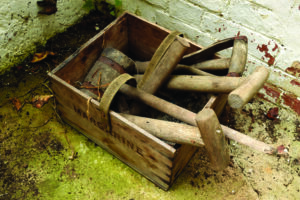
Hand tools and garden tools used and collected today have origins from all over the world.
Early spring has arrived, and you might be headed out to the garden shed to dust off the tools of yard and garden care.
Old garden tools, such as trowels, sickles, hand-forged shears, old saws and more, are often found in flea markets, auctions and shops.
Why do people collect old tools from the 19th through the mid-20th century, and what connection do they have to the past?
Many hand tools we use today have not changed all that much since ancient gardening times.
Hoes, rakes, scythes, spades and others were specifically made in different shapes, usually with hand wrought iron blades and wooden handles to last many different types of weather and harsh conditions as seasons changed.
Understanding origins of tools and their purposes helps the collector also understand origin, use and history today.
Primitive tools are implements made before the Industrial Revolution of the 19th century. In these old types of handmade tools, a buyer can recognize them by identifying hand wrought hammered iron or other metals, hand carved wooden handles with primitive paint schemes, and items cobbled together for very specific uses for a particular problem, like a handle off of one thing, attached to another tool, as ingenuity meets creation and necessity.
Hand tools and garden tools used and collected today have origins from all over the world. Hand shears and some of the very first pruners were used in France, to control vines at the ancient vineyards and to clip grapes.
Rakes and wheelbarrows were said to be first invented in China, where they were used on early cultivation farms and their crops, as well as hauling.
Watering cans and vessels are still found in archeological dig sites all over the world, for the transportation of water to gardens and crops before hoses.
Today, antique gardening tools are used for home and business décor, purchased by museums and educational institutions for historic display and education, and sometimes even for use in the garden.
To find authentic tools from the past, a buyer should look for patina on the metal, rusty coloring or rust itself on iron, weathered or worn paint on handles, aged wood, and signs of makers or country marks stamped into the metal or handles.
Tools that are collected today as a whimsical, fun way to decorate, or for historic purposes to preserve and educated about farming culture and crops of the past, were once a necessity for food, sustenance and life itself.
Once, without these tools, food could not grow, weeds could not be managed, and starvation would be inevitable in cold winter months.
Tools were not only just that, they were the difference between life and death.
Next time you are out shopping and find an old sickle, rake or hoe, remember not only that it would be good as décor or in a historical display, but it also maybe was one of the most important items someone owned.
Think about the history of the first handmade primitive tools, moving forward to early tools made on the first machines, and mid-century tools that saw the rise of mass marketing of easier lives at home, which always includes tools.
The rich heritage of our farming heritage shines through in the old tools we value, admire and still collect today.
They tell a story of our agricultural past.