(Editor’s note: Ron Ketter is a member of the Talbot Bird Club and a Maryland Ornithological Society board member.)
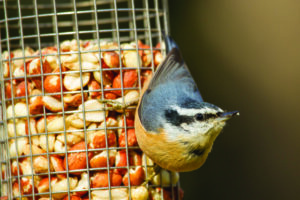
The Red-breasted Nuthatch spends its summers north of here and is a common resident of the boreal forest. Its range covers Pennsylvania, New England, the northern parts of the Great Lakes states, and Canada. It also lives in the Appalachian Mountains extending into Tennessee and Kentucky, as well as from the Rocky Mountain to the Pacific Ocean. (Photos courtesy Ron Ketter)
Nuthatches are a treat to watch as they visit feeders and backyard trees. The Eastern Shore is home to three Nuthatch species.
The first two, the White-breasted and Brown-headed Nuthatches, can be found here all year long, while the Red-breasted Nuthatch is an occasional visitor during the fall and winter months.
The White-breasted Nuthatch is a little longer than 5 inches long. Although it is the largest of the three Nuthatch species, it is a relatively small bird.
White-breasted nuthatches have a large head with a short, thick neck, a short tail, and a long straight or slightly upturned bill that comes to a sharp point. This species has a black or dark-gray cap that extends from the top of its bill to the bottom of its neck, with a white face, throat and underside, and blue-gray back.
White-breasted nuthatches prefer deciduous trees, such as maple, oak, and hickory, although they also can be found in conifers. Their range covers almost all the continental United States, extending into parts of Canada.
The other year-around resident is the aptly named Brown-headed Nuthatch. The top half of its head is brown, extending to the back of its neck where it meets a blue-gray back. The underparts are a dull white color, extending from its chin to the bottom of its tail.
At a little over 4 inches long, the Brown-headed Nuthatch is the smallest of our three nuthatch species.
The Brown-headed Nuthatch is found where pine trees are present. Its range is limited to the Southeast United States, and the Eastern Shore represents its range’s northernmost limit.
The Red-breasted Nuthatch spends its summers north of us and is a common resident of the boreal forest. Its range covers Pennsylvania, New England, the northern parts of the Great Lakes states, and Canada. It also resides in the Appalachian Mountains extending into Tennessee and Kentucky, as well as from the Rocky Mountain to the Pacific Ocean.
Red-breasted Nuthatches are known as partial migrants. The northernmost birds move south annually, with most other residents staying put during most years. However, they periodically exhibit irruptive behavior.
This occurs every few years when a poor crop of conifer seeds or a harsh northern winter pushes them further south in search of food sources.
This year happens to be an irruption year, so keep a look out for Red-breasted Nuthatches. During a big irruption in 2018, I had 20 of them at my feeder at one time!
The Red-breasted Nuthatch is slightly larger than the Brown-headed Nuthatch, but much smaller than the White-breasted Nuthatch. The overall impression of the Red-breasted Nuthatch is a sleek bird with a distinctly patterned head and a reddish wash on its underparts. It has a broad black stripe that runs through its eye, with a bold white eyebrow and a dark cap.
While the Red-breasted Nuthatch typically prefers conifer forests, it can also be found in mixed woodlands, especially outside of their breeding range.
All three species of Nuthatch can be seen clinging to the trunk of trees with head pointing to the ground or hanging on the underside of a pinecone probing for food.
Nuthatches can be quite vocal, and the three species have distinct calls. The Brown-headed Nuthatch sounds like a dog with a squeaky toy, giving off a wheezy two-syllable “Kit-kit” call that is often repeated several times.
The White-breasted and Red-breasted Nuthatch calls are similar, both giving a call that sounds like “yank, yank.” The White-breasted call is at a lower pitch and at a slower pace, while the Red-breasted Nuthatch call is a higher, more nasal tone, repeated more rapidly.
Despite the overall decline in bird populations, the good news is that the population of all three Nuthatch species is stable or, in the case of Red-breasted Nuthatches, has even increased in recent years.
Nuthatches are easily attracted to backyard feeders. They eat nuts, black-oil sunflower seeds, suet, and even peanut butter.
If you live near a mixture of pine and deciduous trees, you may get lucky this winter and have all three species at your feeder.